Wednesday_October_27,2010_mixed_numbers.pptx Wednesday_October_27,2010_mixed_numbers.pptx
Size : 56197 Kb
Type : pptx
THURSDAY_October_21,2010.ppt THURSDAY_October_21,2010.ppt
Size : 840192 Kb
Type : ppt
6.n.20 decimals.ppt 6.n.20 decimals.ppt
Size : 667136 Kb
Type : ppt
Monday October 18,2010.ppt Monday October 18,2010.ppt
Size : 629248 Kb
Type : ppt

Rates, Ratios, Proportions review

October 19, 2010
 

Ratios, Rates, Unit Rates, Proportions SEE WEB LINKS FOR TUTORIAL

October 12, 2010

We use ratios to make comparisons between two things. When we express ratios in words, we use the word "to" -- we say "the ratio of something to something else"


These are all equivalent ratios 3:6 = 12:24 = 6:12 = 15:30


A rate is a ratio that is used to compare different kinds of quantities.

A unit rate describes how many units of the first type of quantity corresponds to one unit of the second type of quantity.

Some common unit rates are miles (or kilometers) per hour, cost per item, ea...


Continue reading...
 

Inverse Property, Identity Property, Zero Property

October 12, 2010
Inverse Property of Addition
Any addend added to its negative will have a sum of zero
Ex: 5 + -5 = 0

Inverse Property of Multiplication
any factor multiplied by its reciprocal will have a product of 1.

Ex: 6 x 1/6 = 1

Zero Property of Multiplication
Any factor times 0 is 0
Ex: 5 x 0 = 0

Identity Property of Addition
Any number added to 0 equals 0
Ex:  7 + 0 = 7

Identity Property of Multiplication
any number multiplied by 1 equals itself.
Ex: 12 x 1 = 12
Continue reading...
 

Distributive Property

October 12, 2010
The distributive property states that multiplying a sum by a number gives the same result as multiplying each addend by the number and then adding the products together.

4 × (2 + 3) = (4 × 2) + (4 × 3)


Continue reading...
 

Associative and Commutative Properties

October 12, 2010

Associative Properties

Associative Property of Addition

o When adding 3 or more numbers, changing the grouping does not change the sum.

(3 + 4) + 5 =  3 + (4 + 5)

7 + 5 = 12    3 + 9 = 12

Associative Property of Multiplication

o When multiplying any 3 numbers, changing the grouping does not change the product.

(3 x 4)x 5= 3x(4 x 5)

12 x 5 = 60       3 x 20 = 60

Commutative Properties

Commutative Property of Addition

o When adding any 2 or more numbers, changing the or...


Continue reading...
 

Place Value

October 12, 2010

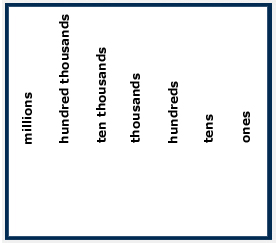
In our decimal number system, the value of a digit depends on its place, or position, in the number. Each place has a value of 10 times the place to its right.


What is standard notation? This is a number written using digits. Numbers as they should appear

What is expanded notation? expanded notation is when each digit is multiplied by its place value.
Ex: 435 = (4 x 100) + (3 x 10) + (5 x 10)  or 400 + 30 + 5


Continue reading...
 

Categories

Blog Archive

This free website was made using Yola.

No HTML skills required. Build your website in minutes.

Go to www.yola.com and sign up today!

Make a free website with Yola